


Angiogenesis is a critical hallmark of cancer progression and a key therapeutic target. INOVOTION’s CAM (Chorioallantoic Membrane) model has proven its predictive relevance and biological precision in studying angiogenesis and anti-angiogenic therapies in vivo.
In this first post of our scientific series, we focus on how Inovotion’s NAMs CAM model enables the robust evaluation of angiogenesis inhibition, as shown in the following studies published in PLoS One and Drug Deliv Transl Res:
1. Comparative In Vivo Evaluation of VEGFR Inhibitors
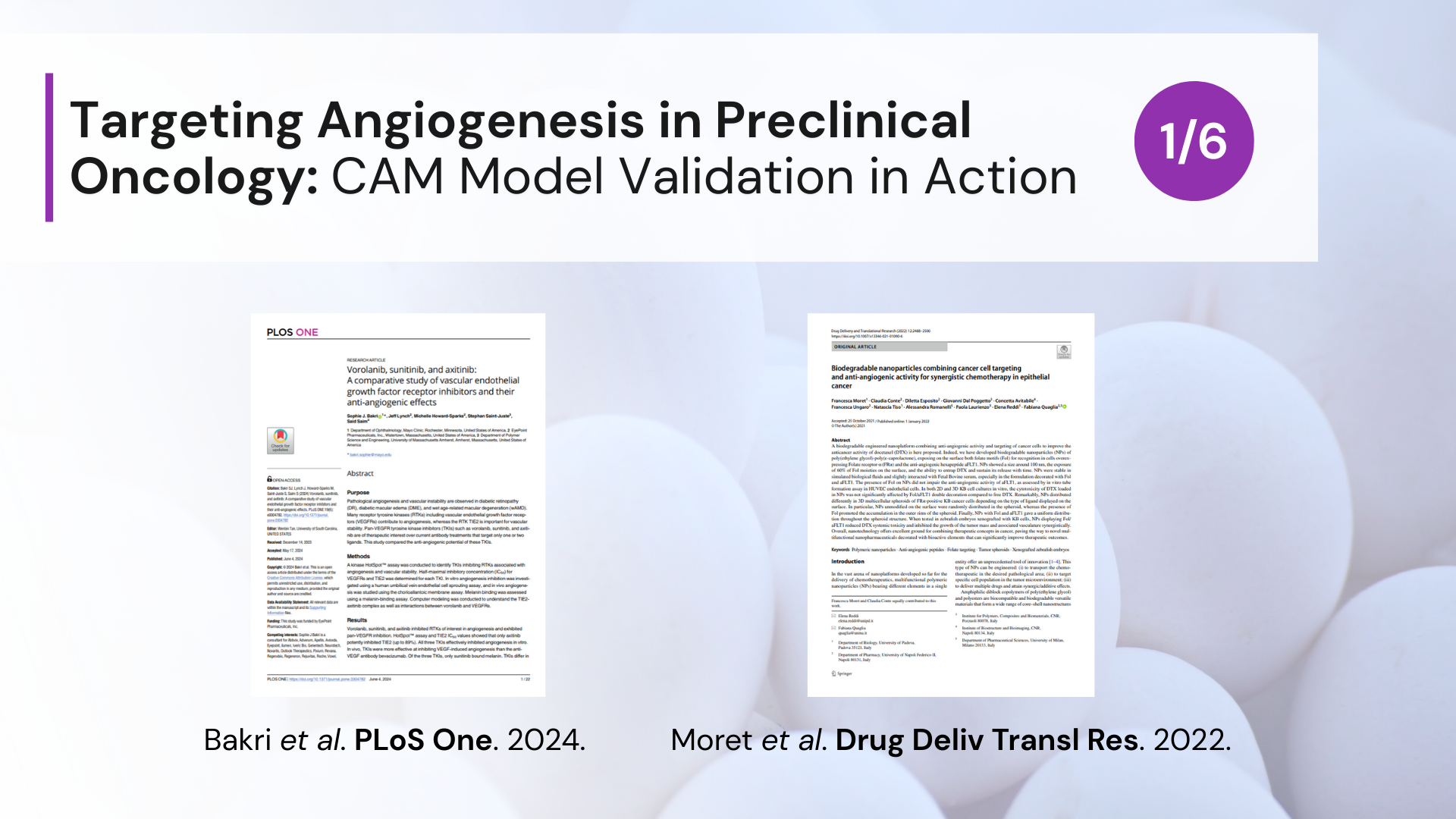
“Vorolanib, sunitinib, and axitinib: A comparative study of vascular endothelial growth factor receptor inhibitors and their anti-angiogenic effects “
Bakri SJ et al., PLoS One. 2024; 19(6):e0304782
A recent study published in PLoS One used Inovotion’s CAM model to compare the anti-angiogenic efficacy of Vorolanib, Sunitinib, and Axitinib. All three inhibitors outperformed bevacizumab in vivo on VEGF-induced angiogenesis. These effects were successfully modeled and quantified using the CAM assay, highlighting its relevance as a sensitive platform for vascular-targeted therapies.
PubMed: https://pubmed.ncbi.nlm.nih.gov/38833447/
2. Nanoparticle-Based Synergistic Chemotherapy with Anti-Angiogenic Action
“Biodegradable nanoparticles combining cancer cell targeting and anti-angiogenic activity for synergistic chemotherapy in epithelial cancer”
Moret F et al., Drug Deliv Transl Res. 2022; 12(10):2488–2500
In a study published in Drug Delivery and Translational Research, researchers used Inovotion’s CAM model to test biodegradable nanoparticles co-loaded with docetaxel and an anti-angiogenic peptide. These nanoparticles showed potent inhibition of tumor-associated vasculature in xenografted zebrafish models – further demonstrating how in vivo systems like CAM or zebrafish are invaluable for rapid, 3Rs-compliant validation of angiogenesis inhibitors.
PubMed: https://pubmed.ncbi.nlm.nih.gov/34973132/
These studies confirm that the CAM model is not only biologically relevant, but also capable of differentiating subtle mechanistic variations between compounds – whether TKIs or nanoparticle-delivered peptides – providing a powerful decision-making tool for early-stage oncology drug development.
Stay tuned for our next post in this scientific series on: Immuno-Oncology.





